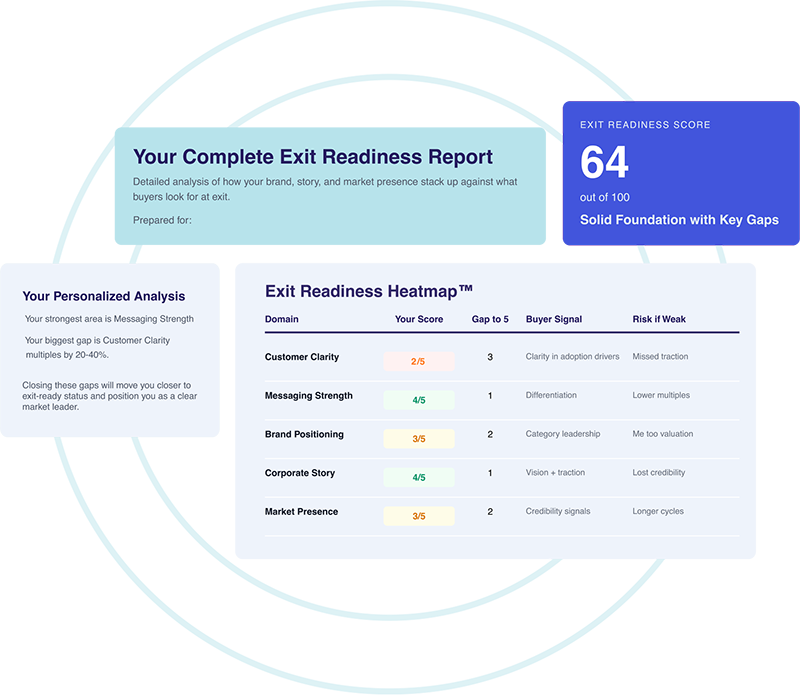
This framework is designed for healthcare, pharmacy, and health-tech companies operating in growth mode while keeping a future transaction (sale, recap, spin‑out, etc) in view. It helps leadership teams pressure‑test growth decisions through a buyer’s lens before those decisions create drag, confusion, or discounted valuation later.
In diligence, buyers aren’t asking “Did you grow?”
They’re asking:
The Exit Readiness Signal Framework focuses on the signals that answer those questions. We’ve seen strong companies lose leverage in diligence not because they lacked growth, but because the growth sent the wrong signals.

Can the growth story be explained clearly and consistently?
Buyers look for a tight narrative that aligns:
Red flags:
Positive signal: A simple, repeatable story that works for customers, partners, and investors alike.
Is growth durable or artificially propped up?
Buyers care less about spikes and more about shape:
Red flags:
Positive signal: Growth that improves margin, predictability, and confidence.
Does growth reduce friction or add complexity?
Every growth investment either simplifies the business, or makes it harder to run and explain
Red flags:
Positive signal: Operations that look intentional, documented, and transferable.
Can the business run without the founder in every decision?
Buyers underwrite teams as much as numbers especially in founder-led companies.
Red flags:
Positive signal: Clear ownership, strong second‑layer leadership, and repeatable decision frameworks.
Are you investing in value creation or value distraction?
Not all growth spend is equal in diligence. Buyers don’t just underwrite ROI. They underwrite whether capital choices made the business easier or harder to own.
Red flags:
Positive signal: Capital deployed in ways that increase optionality and reduce buyer risk.

This framework is designed to be used as a pause button before momentum turns into a mess.
It is most powerful when applied:
Ask one simple question:
Does this decision strengthen or weaken our Exit Readiness Signals?
If the answer is unclear, that’s the signal.
Teams that use this framework consistently:
Exit readiness isn’t a phase. It’s a way of making decisions.
The question most teams miss is whether their current growth choices are strengthening or weakening that posture. This framework reflects how buyers actually evaluate growth in healthcare, pharmacy, and health-tech companies.
Not at LOI. Not at diligence. Now. In every conversation, every investor update, and every partnership discussion where someone is quietly asking: Does this story hold up?
Most teams discover the gaps too late to fix them cleanly. If one or more of these signals gave you pause, that pause is worth paying attention to.
Book your Exit Readiness Diagnostic Call, a focused 30-minute conversation. We’ll walk through where your signals are strongest, where the exposure is, and whether the Exit Readiness Sprint is the right next move for your situation.
No pitch. No pressure. Just an honest read.