Inside the journey from personal conviction to market dominance and what every healthtech CEO can learn about Exit Readiness.
Every great company starts with a problem worth solving. For Hinge Health, that moment came when cofounders Daniel Perez and Gabriel Mecklenburg both experienced musculoskeletal injuries and saw how fragmented and inefficient the recovery journey could be.
In 2014, while pursuing PhDs in London, Daniel in joint and cartilage biology and Gabriel in bioengineering and regenerative medicine, they founded Hinge Health with a vision to reinvent physical therapy through digital innovation and human connection.
As Gabriel explained in The Pulse podcast, “Daniel is the visionary. I am more the builder and manager.” Their complementary strengths became the foundation for a company that turned personal pain into a billion-dollar opportunity.
Early versions of Hinge Health were tested in the UK but struggled to gain traction. As Daniel recalled, “It was easier to schedule meetings with U.S. customers from London than in London itself.”
The founders shifted focus to the U.S. employer market, where self-insured companies were seeking cost-effective ways to improve employee health and reduce musculoskeletal expenses.
That pivot, combined with perseverance through early sales challenges, became the turning point. As Gabriel noted, “In the early days, sales took a ton of perseverance. The hardest part wasn’t getting the first meeting. It was closing and converting the sale.”
They also discovered that messaging mattered as much as product. Hinge’s marketing team learned early to lead with clarity, not complexity. Their simple promise, “Take control of your pain. Recover from injury. Even prepare for surgery,” replaced jargon with benefit-driven language that resonated with both employers and employees.
Hinge Health’s breakthrough came when they achieved product-market fit in the U.S. employer benefits space. By combining wearable sensors, app-based therapy, and clinical coaching, the company delivered measurable outcomes: reduced pain, improved function, and lower claims costs.
Gabriel later shared that “four in five employers with a digital MSK solution partner with Hinge Health.” That kind of clarity and traction turned a niche idea into a national standard.
As the company scaled, it introduced hybrid care, pairing virtual therapy with in-person evaluations when needed. Gabriel described it as “combining the best of digital and in-person care, a physical therapy house call service integrated with the digital experience.”
At the same time, the team made brand clarity a strategic advantage. Their website and campaigns focused on outcomes, not algorithms. Instead of talking about “digital MSK interventions,” their homepage led with direct value: “Reduce your pain now.” Every touchpoint reinforced the same benefit, creating consistency and trust across patients, employers, and investors.
Once momentum was established, Hinge Health focused on scaling with discipline and differentiation. Their growth playbook, described by Daniel Perez in the Vital Signs podcast, emphasized four pillars:
By 2024, Hinge Health reported revenue of approximately $390 million and guided 2025 revenue between $548 and $552 million. In Q2 2025 alone, revenue reached $139.1 million, a 55 percent year-over-year increase.
Their platform leveraged AI, motion tracking, and automation to scale efficiently. Perez noted that AI tools reduced 95 percent of clinician hours previously required for physical therapy sessions, giving the company a level of operational leverage that buyers value highly.
By 2025, Hinge Health had more than 2,000 enterprise customers, representing over 20 million covered lives and nearly 80 percent market share in digital MSK care.
The company also invested in its brand as it scaled. A refreshed identity emphasized member health journeys and the belief that movement unlocks human potential. Consistent messaging across web, PR, and employer materials made the brand instantly recognizable.
Hinge Health’s differentiation extended beyond technology. Their partnerships with global insurers embedded them into enterprise benefit structures, deepening integration and defensibility. Industry analysts cited their unique business model, provider partnerships, and cost-saving outcomes as the primary drivers of their market leadership.
From an Exit Readiness standpoint, Hinge Health mastered the three signals acquirers look for: a clear customer promise, repeatable proof, and brand authority. Each reinforced the other, creating valuation gravity that positioned the company for a strong IPO.
The same clarity that made Hinge Health the obvious choice for employers and investors is what most mid-market healthtech companies lack, and what separates a 3x exit from a 7x one.
What made Hinge Health irresistible to buyers was not luck. It was clarity, credibility, and disciplined growth, all hallmarks of Exit Readiness.
They defined their category with precision.
They told a story that customers, partners, and investors could repeat.
They built proof that scaled and a brand that signaled leadership.
Buyers didn’t need to dig to see the value. It was obvious.
If your positioning feels fragmented or your brand story is hard to articulate, you’re leaving valuation on the table. The same clarity that elevated Hinge Health can make your company the one buyers fight to acquire.
The same clarity, credibility, and disciplined growth that made these companies irresistible to buyers are the same fundamentals that determine your valuation.
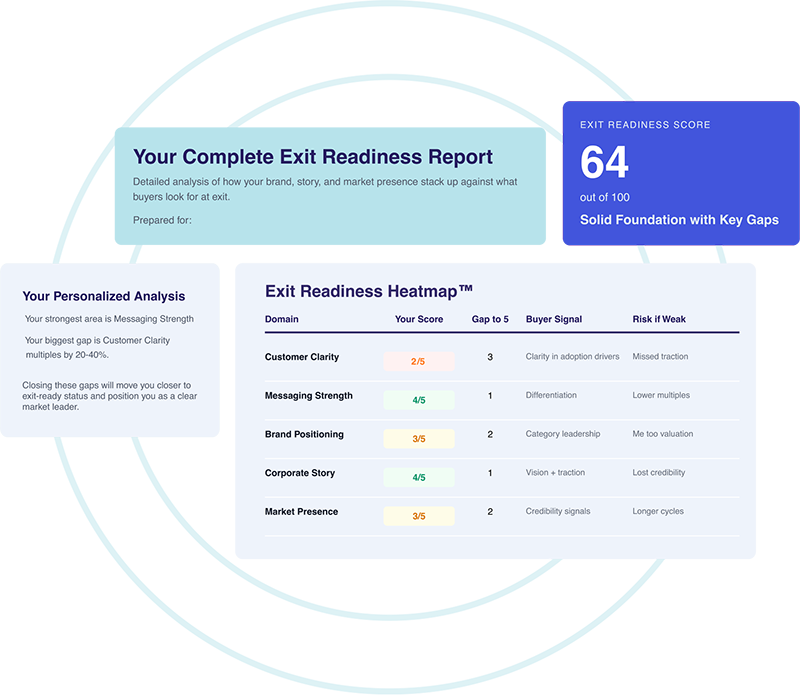
If you have already completed your Exit Readiness Scorecard™, your next step is a private Exit Readiness Diagnostic.
In this 30-minute session, we’ll:
You’ll leave with a clearer picture of how buyers view your company and the exact steps to strengthen your position before your next funding round or acquisition process.
Book Your Exit Readiness Diagnostic
If you’re ready to accelerate that transformation, explore the Exit Readiness Sprint™, a 90-day program that builds the personas, messaging, positioning, and corporate story that make buyers take notice.