
STAGE 5 · ENTERPRISE VALUE CREATION SYSTEM™
Buyers don't reward effort. They reward evidence.
How Healthcare Buyers Evaluate Companies
Understanding how buyers actually evaluate your business is the only way to build toward the outcome you want.
Most companies prepare for a transaction by improving the story. Better decks. Cleaner financials. A sharper narrative. That work matters. But it doesn't move the multiple.
What moves the multiple is risk reduction. Buyers aren’t primarily evaluating upside. They're evaluating what could go wrong and whether the company has already done the work to make those risks visible, documented, and manageable.
The companies that earn premium valuations demonstrate consistency. They show how their growth holds under pressure — across markets, leadership changes, and competitive cycles. That's what a buyer is actually looking for.
The exit is won long before the go-to-market process begins. Most companies start preparing too late.
Buyers don't reward effort. They reward evidence.
See the four lenses sophisticated buyers use to evaluate healthcare companies — and how to align to all of them.
The Buyer Evaluation Model
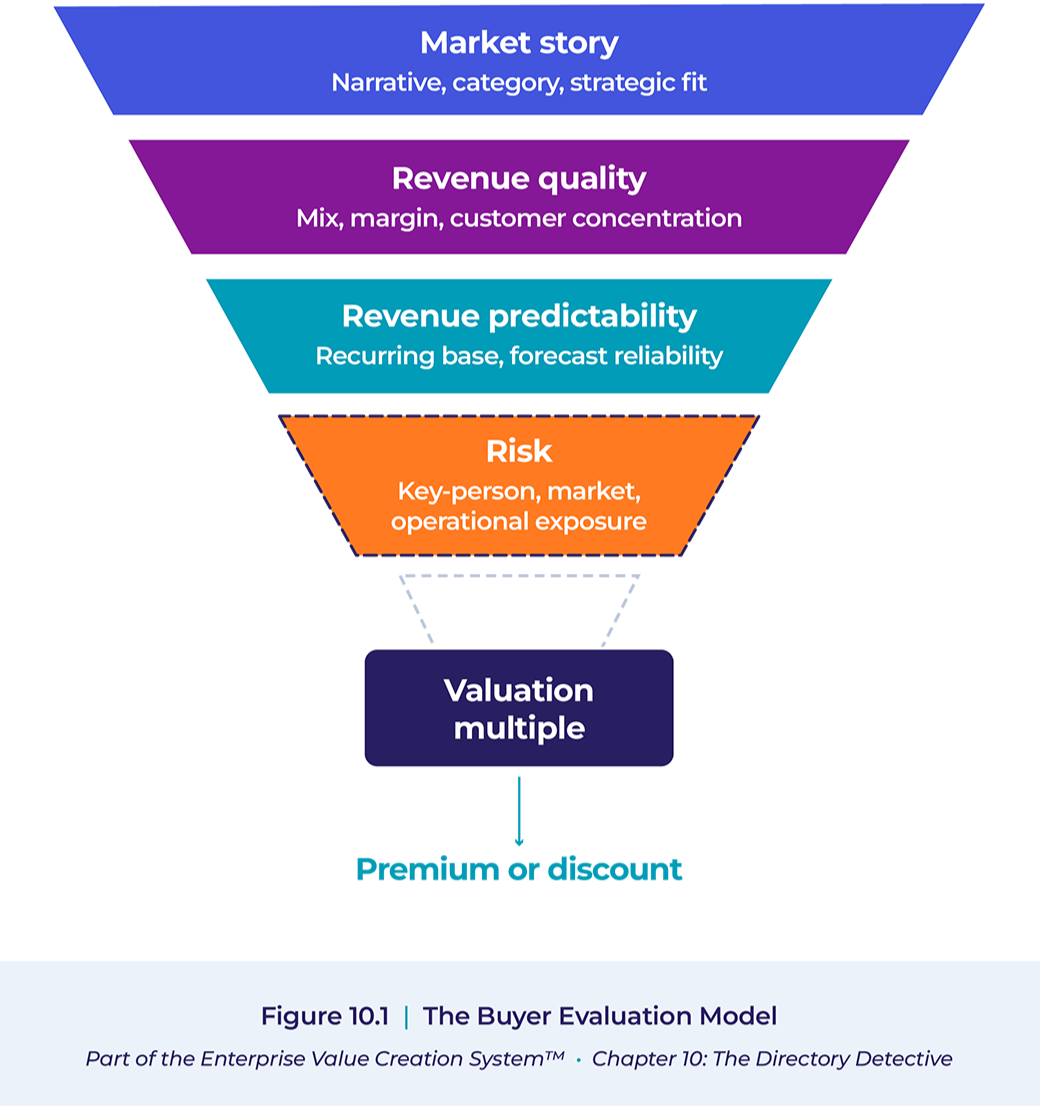
The Buyer Evaluation Model maps the four lenses through which any sophisticated buyer — strategic or financial — evaluates a healthcare company. Each lens represents a distinct category of risk and confidence. Together, they determine whether a buyer sees a premium acquisition or a discounted project.
Most companies optimize for one or two lenses and leave the others unaddressed. That asymmetry is what creates the gap between expected valuation and actual offer. The diagram makes the four lenses explicit so you can evaluate your own business the way a buyer will — before they do.
Where this shows up
You see it when a strong business receives an offer lower than it deserved. When diligence surfaces concerns that weren't anticipated. When a buyer who seemed enthusiastic during early conversations gets cautious once they look more closely. When the deal closes, but at a number that didn't reflect the value the team knew was there.
The gap between what a company is worth and what a buyer pays for it is almost never about the quality of the business. It's about the legibility of that quality under scrutiny.
What changes when you fix it
When your business is aligned with how buyers actually evaluate it, the process changes materially. Diligence is faster because there are no surprises. Buyers develop conviction earlier and hold it longer. The narrative holds under scrutiny because the structure behind it is real.
That's the work that produces higher valuations, and it starts long before any diligence process begins.
Ready to uncover the gaps in your growth?
Schedule a Strategic Fit Call with Dr. Roxie Mooney. In 45 minutes, you’ll talk through where your business is most exposed, your top growth opportunities, and whether you’re a good fit for a deeper engagement with Legacy DNA.