We specialize in the sectors where commercial clarity is a valuation lever, not a marketing exercise.
Mid-market healthcare is not a single market. Pharmacy buyers evaluate businesses differently than healthtech acquirers. Women's health companies carry a different burden of proof than longevity companies. AgeTech operates in a different multi-stakeholder buying environment than any of them.
Book a Strategic Fit Call →


Pharmacy is one of the most operationally complex sectors in healthcare. Margins are under pressure. Buyers are sophisticated. Scrutiny is high and gets higher as the process advances.
Strong performance isn't enough if the story, proof, and positioning don't match how buyers actually evaluate pharmacy businesses. That gap is where value gets discounted.
Book a Strategic Fit Call →- The business is performing well but buyers don't fully understand or value what's been built
- Growth happened through relationships and operational excellence, not a structured commercial system
- The story depends too heavily on leadership knowledge or key individual relationships
- Buyers are asking detailed diligence questions that expose gaps in narrative or proof
- Strong financials still prompt cautious questions rather than confident offers
- Mid-market pharmacy companies preparing for growth or exit
- Specialty pharmacy, PBM-aligned, or complex service models
- Leadership teams facing increased buyer or investor scrutiny
- Companies where strong financials aren't producing the buyer confidence the numbers should support
- Early-stage businesses without operational maturity
- Teams looking for marketing execution without strategic alignment

Most healthtech companies we work with aren't struggling to grow. They're struggling to make that growth legible, to buyers who are increasingly risk-sensitive, to boards who want proof not potential, and to investors who've seen too many promising companies get discounted in diligence.
The gap between what the business is producing and what it's worth is where most healthtech enterprise value is lost.
Book a Strategic Fit Call →- Buyers become more risk-sensitive as the company grows, they evaluate proof, not potential
- Sales cycles extend to 12 to 24 months with more stakeholders in the room
- Positioning and messaging fragment as the team expands
- Marketing, sales, and product each tell a slightly different story
- The narrative that got the company to $20M starts to break at $75M
- Mid-market healthtech companies with $10M to $250M in revenue
- PE-backed, VC-backed, or founder-led, with an exit or capital event on a 12 to 36 month horizon
- Companies where growth is real but the commercial story isn't consistently landing with buyers and investors
- Early-stage companies still finding product-market fit
- Teams looking for demand generation or campaign execution without strategic alignment

Many women's health companies find that the momentum that drove early growth, a clear mission, strong outcomes, a passionate market, doesn't translate cleanly when buyers and investors start evaluating the business through a risk lens.
The story has to do more than resonate. It has to hold up under diligence.
Book a Strategic Fit Call →- The value story is compelling internally but doesn't land with enterprise buyers
- Proof exists but isn't structured in a way that reduces buyer risk quickly
- Growth feels fragile or inconsistent as the market evolves
- The narrative leans on mission when buyers are evaluating performance and transferability
- Deals stall late or take longer than they should without a clear reason
- Mid-market women's health companies scaling beyond early traction
- VC-backed or PE-owned, with buyers or investors in view
- Leadership teams where the mission is clear but the commercial story isn't closing deals the way it should
- Early-stage companies still validating demand
- Teams looking for execution-only marketing or brand work

Longevity is one of the fastest-growing and most scrutinized sectors in healthcare. Buyers and investors evaluate longevity companies through a risk-first lens, and the market is already full of companies that eroded trust by overpromising.
Getting the commercial story right isn't optional here. It's the primary driver of whether growth translates into enterprise value.
Book a Strategic Fit Call →- Science is strong but the value story isn't landing with buyers or investors
- Translating complex data into clear, commercial positioning without oversimplifying is unresolved
- Buyers are interested but hesitant, perceived risk is higher than the evidence warrants
- The category is crowded with bold claims, making credible differentiation harder
- Growth exists, but confidence in how it will hold up under scrutiny is low
- Mid-market longevity companies with real clinical or scientific evidence and a growth story that isn't fully landing
- VC-backed or PE-owned, with investors or acquirers in view
- Leadership teams where credibility is a known challenge, in category perception or in the proof set itself
- Early-stage companies still building an evidence base
- Companies whose challenges are primarily operational or clinical, not commercial

Technology evolves quickly in AgeTech. Trust is earned slowly. That gap, between what the solution actually does and what different buyers are willing to believe, is where most AgeTech enterprise value is lost.
Book a Strategic Fit Call →- Multiple stakeholders influence decisions but the message doesn't land consistently across them
- Solutions are valuable but hard to explain quickly and credibly
- Sales cycles are long with deals stalling at different stakeholder levels
- Growth depends too heavily on individual relationships or founder involvement
- Traction exists but isn't predictable, repeatable, or transferable
- Mid-market AgeTech companies scaling beyond early traction
- B2B or B2B2C models with complex buying groups
- Leadership teams dealing with inconsistent growth, long sales cycles, or fragmented messaging
- Early-stage companies still validating demand
- Teams looking for more sales activity rather than structural alignment
What Legacy DNA does
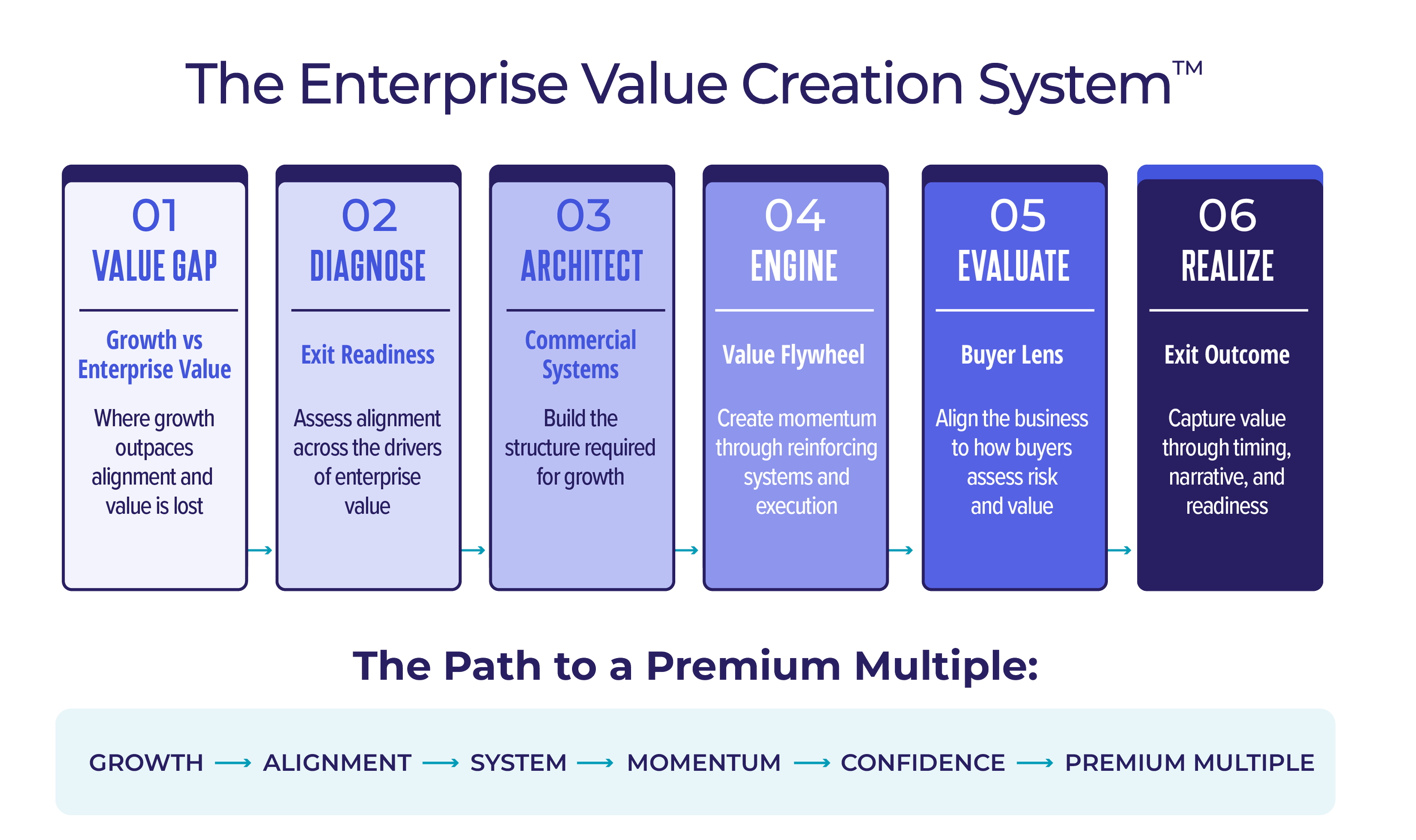
Legacy DNA builds the commercial system that closes the gap between what your business is producing and what it's actually worth. The Enterprise Value Creation System™ is the framework we use — a six-stage model that maps where alignment is breaking and what to fix, in the order that creates the most leverage.
This is not strategy consulting or agency work. We operate inside the business to build the system. The work is senior-led by Dr. Roxie Mooney and designed to hold up in board presentations, investor conversations, and diligence rooms.