
STAGE 6 · ENTERPRISE VALUE CREATION SYSTEM™
Enterprise value is the result of decisions made over time.
Where Enterprise Value Is Realized
Companies that earn premium valuations build their enterprise value long before the exit process begins. The outcome of a transaction is determined by the quality of the decisions that preceded it by months and sometimes years. The exit is the reading of the meter, not the accumulation of the charge.
Premium valuations aren’t awarded to the companies with the most momentum. They’re the ones with the most clarity, the greatest alignment, and the most proof that what they built will keep working under new ownership, under new conditions, and under market pressure no one has anticipated.
Growth that can be repeated is valuable. Growth that depends on individuals, timing, or favorable conditions is risky. That distinction is what determines the multiple.
Enterprise value isn't created at exit — it's revealed there.
See the final stage where the decisions you've made either hold or break under buyer scrutiny.
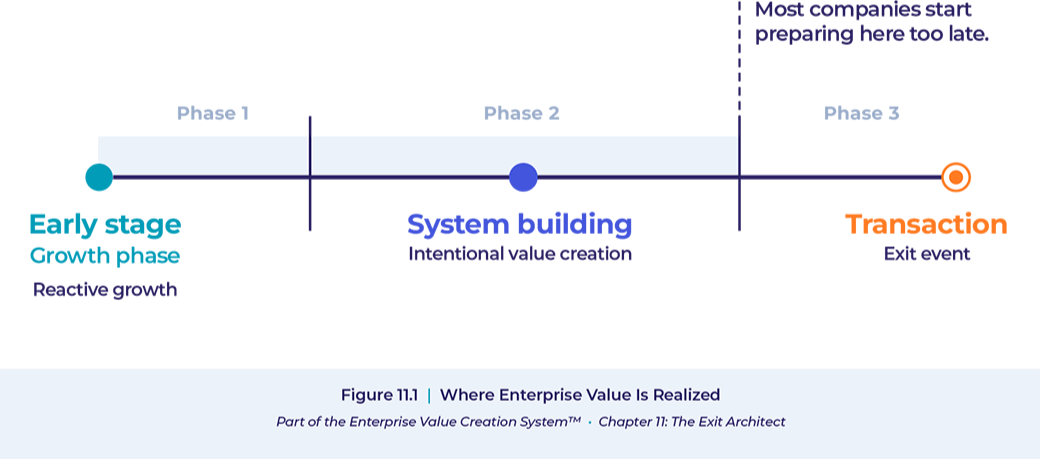
Where enterprise value is realized
This diagram maps the moment when the work of the prior five stages either holds or breaks. Every dimension a buyer evaluates — the clarity of the commercial system, the repeatability of growth, the strength of the narrative, the quality of the operational infrastructure — is shaped by decisions that happened long before any go-to-market process began.
Value realization is a lagging indicator output. You can not optimize for it at the end. You build toward it from the beginning, and you arrive at a number that reflects your system building.
How the EVCS™ comes together
Most companies prepare for a transaction by improving the story. Sharper decks. Cleaner financials. A more polished narrative. That work has a role, but it does not move the multiple.
What moves the multiple is the degree to which a buyer can look at the business, understand exactly how it works, trust that the performance they see is repeatable, and verify that the system producing that performance does not depend on any single individual still being in the room after the deal closes.
Buyers aren’t solely evaluating upside. They’re also evaluating the risk, downsides, and potential problems they will own. Premium valuations are awarded to organizations that have mitigated those risks through the structure of what they built.
Where this shows up
You see it in diligence that takes longer than it should. In valuation conversations where the buyer's number doesn't align with the seller's expectations. In deal processes that stall at a moment when momentum should be building. In a final offer that reflects concerns no one raised until it was too late.
The diagnostic surfaces those risks early enough to actually do something about them. That's the difference between a company that enters a process and a company that's ready for one.
What changes when you fix it
When all five dimensions are aligned, the business tells a consistent story from every angle. There are no surprises in the data room. No gaps for a buyer to probe. No asymmetry between what the management team believes and what the data supports.
Clarity is the most underrated driver of premium valuation. A business that's easy to understand, trust, and verify earns more — not because the numbers are better, but because the risk is lower.
Ready to uncover the gaps in your growth?
Schedule a Strategic Fit Call with Dr. Roxie Mooney. In 45 minutes, you’ll talk through where your business is most exposed, your top growth opportunities, and whether you’re a good fit for a deeper engagement with Legacy DNA.