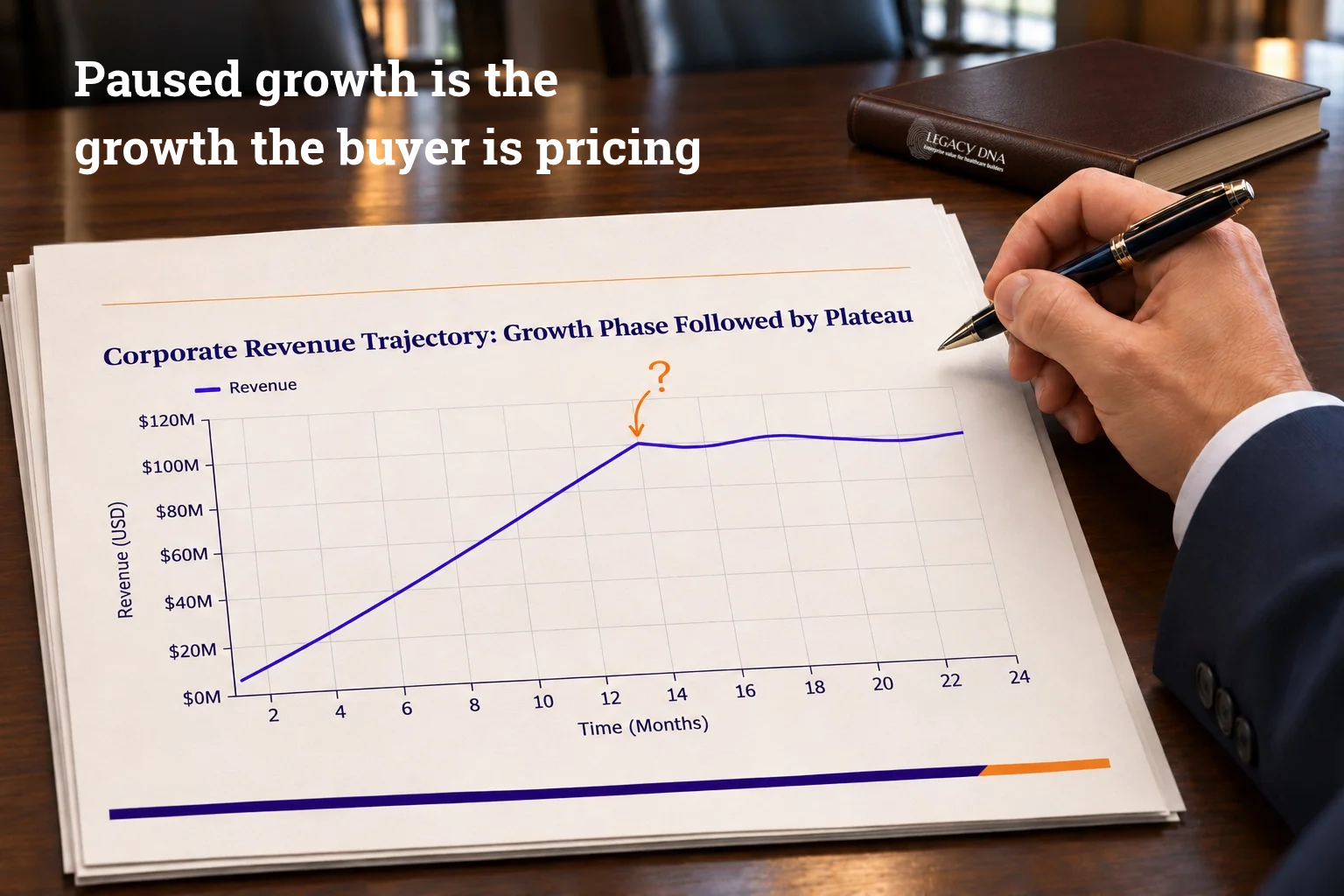
Most sponsors know a company tends to go quiet during a sale process. Growth initiatives pause, a repositioning gets shelved, the new segment waits until after close, and discretionary spend gets trimmed to show a cleaner margin. Meanwhile, competitors keep investing, launching, and selling into the same customers. What the seller rarely sees is what that costs, because much of the loss doesn't show up until years later, long after anyone connects it to the sale.
Some of it shows up much sooner. A process runs for months, and the buyer reads every one of them. The quiet shows up in the trend the buyer prices, the forecast the buyer checks, and the market the buyer calls. By the time it reaches the next owner, it has already reached the price.
What stops when a company goes quiet
It rarely stops all at once. It stops one postponement at a time, and each postponement is reasonable.
The territory expansion moves to next year's plan. The value case for a new customer type never gets finished. The commercial hire who would have opened a new segment gets held, because a new leader is one more thing a buyer will ask about.
Then the spending tightens, and this is the bind. The company is selling its growth, so growth can't fall off. It's also managing to the EBITDA a buyer will price, and discretionary investment is the easiest place to find margin. That reflex isn't unique to a sale. In Graham, Harvey, and Rajgopal's survey of 401 senior financial executives at public companies, close to 80 percent said they would cut discretionary spending such as research, advertising, and maintenance to hit an earnings target.
None of these looks like a decision to stop competing. Together they are one.
Where the advice to hold still is right
Bankers, most sponsors, and most CFOs in a live process give the same advice: don't introduce variables mid-diligence. They're right about part of it. A rebrand, a pricing overhaul, or a reorganization halfway through diligence hands the buyer a question nobody can answer yet, and an unanswerable question becomes a discount or a delay.
Cost discipline is part of the right answer too. Cutting spend that doesn't feed the growth story can strengthen it.
The advice fails when it's applied by default to everything. Not introducing variables means holding steady on what a buyer is actively diligencing. It doesn't require stopping the commercial work that produces next year's revenue. Most leadership teams never draw that line, so the advice spreads until it covers the whole commercial calendar, and a choice made to protect the transaction ends up putting the price at risk.
Why the buyer sees the quiet and prices it
The quiet lands in the months a buyer reads most closely.
Middle-market sell-side advisors commonly plan six to 12 months for a process. Through that window, the buyer asks for current results and checks them against the projections in the CIM, and a quality of earnings review works from the trailing months. A top line that slows mid-process doesn't hide in a footnote. It's the newest data the buyer has. The same is true for an independently owned company preparing for its first institutional raise. The investor reads those months too, and the options a raise was meant to buy narrow with them.
And the process is only the middle of the window. Many advisors recommend starting preparation a year or more before launch, and if the buyer integrates the company, commercial attention stays diverted well past close. The quiet that starts in preparation can outlast the process by a long way.
Why trimming spend doesn't protect the price
Trimming spend doesn't offset the slowdown. EBITDA is one part of the price. The multiple reflects what the buyer believes those earnings can become, and the investment and risk it will take to get there. Morgan Stanley's Michael Mauboussin and Dan Callahan put growth, returns on investment, and risk at the center of what a business is worth. Some of the work that produces future growth, such as winning customers, runs through today's expenses, so cutting it can make this year's earnings look better before the loss of growth shows up. A trim that lifts the margin while growth slows can strengthen one part of the price and weaken the other.
The margin may not hold, either. If a buyer concludes the costs that were cut have to come back to sustain the business, it can challenge whether the higher EBITDA is real.
Buyers are looking for exactly what the quiet removes. Bain partners who worked through exit planning with dozens of portfolio companies say buyers want measurable proof that growth is already happening, not a description of what comes next. A commercial calendar that went quiet during the process leaves less of that proof to show.
When the slowdown shows up after the letter of intent, it can become a reason to re-trade. When it shows up earlier, the growth case can get discounted before anyone makes an offer. When the process stalls, the company may go back to market later with a slower trend and a reputation for having been shopped.
The cost doesn't stop at close for anyone rolling equity or carrying an earnout. A new sponsor arrives with a value creation plan built on the trend it bought. A strategic acquirer, or a platform adding the company as a bolt-on, brings integration. Decision rights move with ownership, so a commercial problem the company could have fixed on its own calendar now waits for someone else's. A company that chose to deprioritize its market could choose again. A company that has lost the ability to respond at its own pace can't, and that's the worse problem.
Every one of those costs lands on people sitting at the table today.
Why competitors get an opening during a process
Healthcare services and technology often have long sales cycles and real switching costs. Customers who sign with someone else during a process sign agreements with terms, and that business may not come back on the seller's timetable.
Competitors aren't distracted by an exit. While the selling company packages its story and manages its margin, they're in front of its customers, launching what's new, and expanding into the segments it postponed. Where the seller trims investment to show the strongest EBITDA, a competitor that keeps investing gets a window to leapfrog it. McKinsey's work on merger integration describes competitors using deal anxiety to recruit the other side's best salespeople and win away its customers. Commercial diligence often includes customer calls and a look at share, and a competitor that spent the process in front of your customers can show up in both.
The competitors you know aren't the only ones in the room. A sale process is exactly the window a newly funded entrant needs. It gets in front of your customers with something that looks new, hires the people you postponed, and launches while you hold still. Growing but holding is a stance your customers can see too.
Healthcare isn't exempt, and the pressure starts before a deal exists. When takeover speculation surrounded Smith & Nephew, its CEO, Olivier Bohuon, told the Financial Times, as BioSpace reported, that the talk had disrupted the sales force, because its reps were in the field every day alongside competitors telling them their company was about to be bought. A live process hands competitors a stronger version of that pitch, and a seller that has trimmed its investment gives them something to back it up with.
Some of that loss shows up before the buyer finishes checking. Some doesn't. With long sales cycles, a customer that signs with a competitor mid-process may not show up in the revenue line until after close. That part never reaches the price. It reaches the business, and the market the new owner inherits isn't quite the one it diligenced. For anyone rolling equity, it's the same people paying twice.
Why the CEO and the sponsor pay for the quiet together
The CEO in a process is running two jobs and is judged on one of them. Saying the company is drifting in the market sounds like a forecast miss, and nobody wants to say that in the middle of a sale.
The sponsor can see the commercial calendar emptying out and has its own reason for silence: the alternative is asking management to take risk in front of buyers.
Both are protecting the same number, and the silence is what puts it at risk. The cost doesn't land on the next owner first. It lands on the price both of them are waiting for, and for a CEO rolling equity, it keeps landing after close.
What lets a company keep competing through a process
Ignoring the bankers won't fix this. Needing less of the leadership team's attention to keep competing will, and that has to be built before preparation starts, because preparation is when the people who would build it are least available.
Three things make the difference. First, the commercial motion is documented and owned by named people below the executive team, so it doesn't stop when the executives are in management meetings. Second, every growth initiative is sorted before the window opens: the things a buyer will diligence, such as brand architecture, pricing structure, and organization design, hold steady, while the work that wins next year's customers keeps running. Third, the growth story a buyer hears is built on initiatives that are visibly moving, rather than plans described as starting after close.
BioPlus grew from $750 million to $2 billion through two ownership transitions, with 24 consecutive quarters of growth. I held the fractional CMO seat, and Legacy DNA was agency of record across that period. That kind of run doesn't come from a company that goes quiet every time a transaction is on the calendar.
Those three things are commercial system work, and the sort at the center of them is a decision about what to start, stop, and keep doing. A company that has it holds still on what the buyer is diligencing and keeps the growth the buyer is pricing visibly moving.
The buyer doesn't price the quarter you protected. It prices the trend you stopped.
Dr. Roxie Mooney is founder and CEO of Legacy DNA. Legacy DNA builds the commercial systems that let mid-market PE-backed and independently owned healthtech and pharmacy companies grow, scale, and exit at a premium.
Sources:
Bain & Company, "Six Ways to Accelerate Exit Momentum" (June 2026): https://www.bain.com/insights/six-ways-to-accelerate-exit-momentum/
Michael J. Mauboussin and Dan Callahan, "Valuation Multiples: What They Miss, Why They Differ, and the Link to Fundamentals," Morgan Stanley Counterpoint Global (April 2024): https://www.morganstanley.com/im/publication/insights/articles/article_valuationmultiples.pdf
John R. Graham, Campbell R. Harvey, and Shiva Rajgopal, "The Economic Implications of Corporate Financial Reporting," Journal of Accounting and Economics (2005): https://doi.org/10.1016/j.jacceco.2005.01.002
McKinsey & Company, "Perspectives on Merger Integration" (2010): https://www.mckinsey.com/capabilities/people-and-organization/our-insights/merger-management-compendium
Financial Times interview with Smith & Nephew's CEO, as reported by BioSpace, "Why Smith & Nephew plc's CEO Is Shy of Megamergers" (2015): https://www.biospace.com/why-smith-and-nephew-plc-s-ceo-is-shy-of-megamergers