
Two healthcare legends. Two bold bets. One exposed the gap every growth company must close. One proved what happens when you close it. Together, they teach the full lesson.
Conviction is not free
Every growth story starts with conviction. Yours did. But conviction has a price, and most CEOs don't know what they're paying until the bill arrives: in a board meeting, in a diligence room, in a valuation that doesn't match the effort.
Ali Parsa and Iman Abuzeid both bet everything on a future the healthcare establishment refused to imagine. Both faced skepticism, bias, and institutional resistance. Both forced the industry to respond, and both changed it permanently.
Their journeys took different shapes. One surfaced a truth about growth that the entire industry needed to see. The other proved what that truth makes possible.
Neither story is a cautionary tale. Together, they're a masterclass in what separates growth that compounds from growth that stalls under scrutiny. And if you're running a PE-backed health company with an exit clock ticking, it's the most important pairing you'll read this year.
Parsa: The founder who mapped the terrain
Ali Parsa arrived in Britain at sixteen, a refugee with no money, no connections, and a pocket dictionary. He fought his way to a Goldman Sachs directorship, then walked away to build. In 2013, he founded Babylon Health with a rallying cry that sounded outrageous: an AI doctor in every pocket.
The vision moved markets. $550 million in a single round. Millions of patients across the UK and Rwanda. A near $4 billion NYSE debut. Parsa accelerated telehealth adoption, put AI at the center of the healthcare conversation, and gave millions their first taste of virtual care.
Then the SPAC market collapsed, capital tightened, and Babylon's run ended. What surfaced was a truth Parsa now understands better than almost anyone: vision unlocks growth, but structure sustains it. He didn't stop. He started again, smarter, and with a map no one else had.
Abuzeid: When reality catches up to the story
Iman Abuzeid saw the same kind of systemic failure, a nursing shortage bleeding hospitals dry, and made an equally audacious bet. In 2017, she flipped the hiring model: hospitals would compete for nurses, not the reverse.
The resistance was brutal. Investors who didn't see a billion-dollar founder in a female physician. Health systems allergic to change. Nurses burned too many times to trust another platform.
Abuzeid treated every “no” as data. She refined the pitch until the evidence was undeniable: hires in 14 days against an 82-day national average. Cost per hire down more than 60%. Retention up because nurses were matched, not placed.
By 2022, Incredible Health was a $1.65 billion company serving what is now 700+ health systems, including Johns Hopkins and Stanford. The investors who passed came back chasing her.
The difference buyers pay for
Here's the uncomfortable truth both stories expose: buyers don't pay for conviction. They pay for conviction with proof behind it.
Parsa and Abuzeid both sold futures that didn't exist yet. Every founder does. Vision is what unlocks capital, talent, and early adoption. The question is what happens next: does reality catch up to the story?
Parsa's journey exposed that question at global scale, giving every founder after him a clearer view of the gap between promise and structure. Abuzeid's journey answered it. Every claim had a metric. Every metric had a heartbeat behind it. The narrative and the numbers moved together, which is exactly what a diligence team is built to test.
That's the real cost of conviction: the discipline to build the commercial system that makes your story defensible before someone else stress-tests it for you. Parsa named the price. Abuzeid showed the payoff.
The question you should ask
You're not choosing between Parsa's audacity and Abuzeid's rigor. You need both. The question is whether your ambition is outpacing your structure, and whether you'd know before your board does.
Ask yourself:
If growth accelerated tomorrow, would the business hold or start to break?
Can every claim in your growth story survive a buyer's diligence team?
Are you distinguishing signal from noise in your performance, or just doing a lot?
If you hesitated on any of these, the gap is already forming. It looks like a growth problem. It usually isn't. It's alignment between what the business produces and what it's actually worth.
Close the gap before the deal room finds it
Parsa changed the conversation and turned a hard-won lesson into the clarity to build again. Abuzeid changed the system and built enterprise value that compounds. Both left a mark on healthcare that can't be erased. Your advantage: you get their combined lesson without paying their tuition.
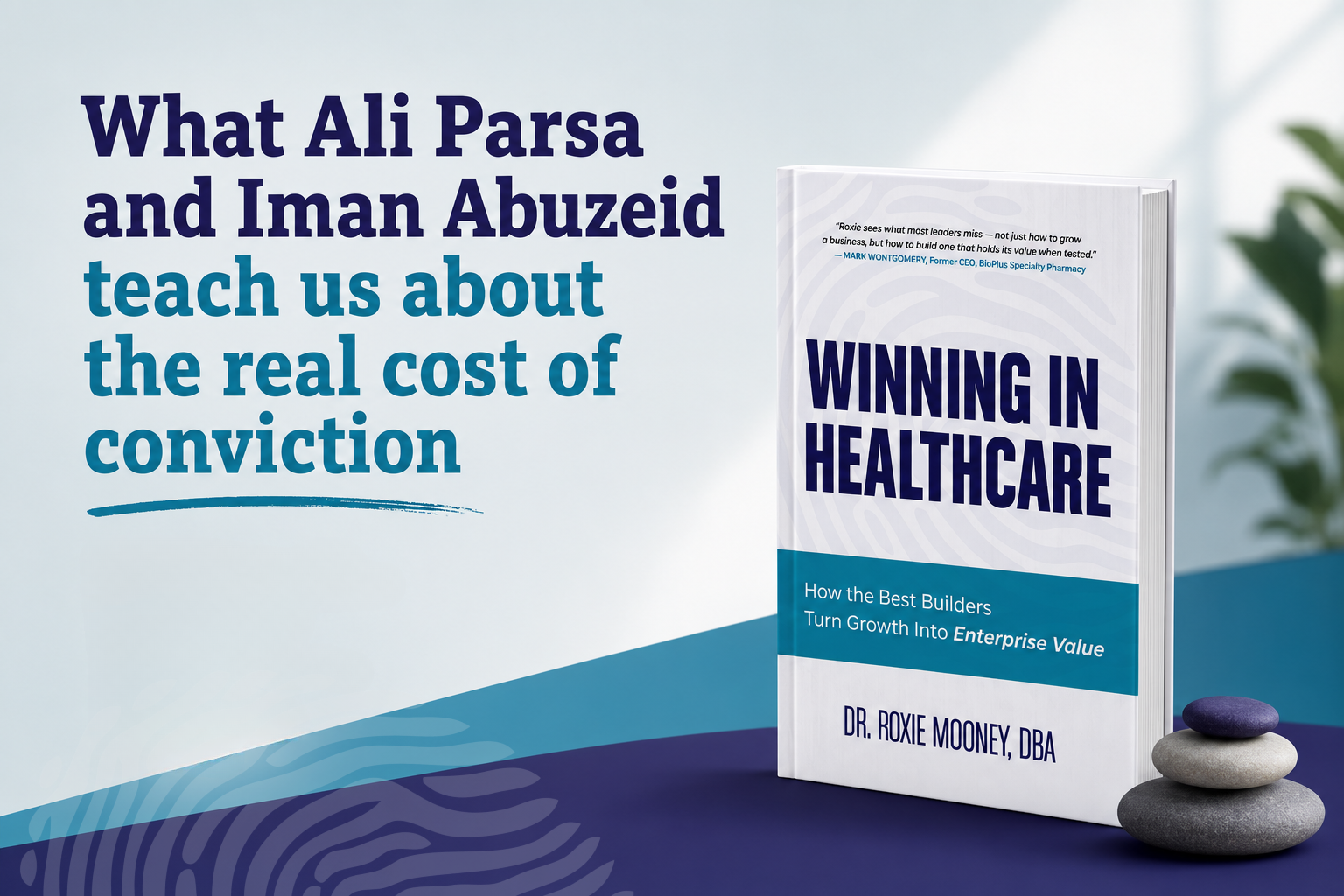
Their full stories, and the Enterprise Value Creation System behind them, are in Winning in Healthcare. It's the playbook for turning growth into enterprise value that holds under scrutiny.
Get your copy of Winning in Healthcare on Amazon:Buy the book now