
Meet the 11 builders behind Winning in Healthcare: How the Best Builders Turn Growth Into Enterprise Value
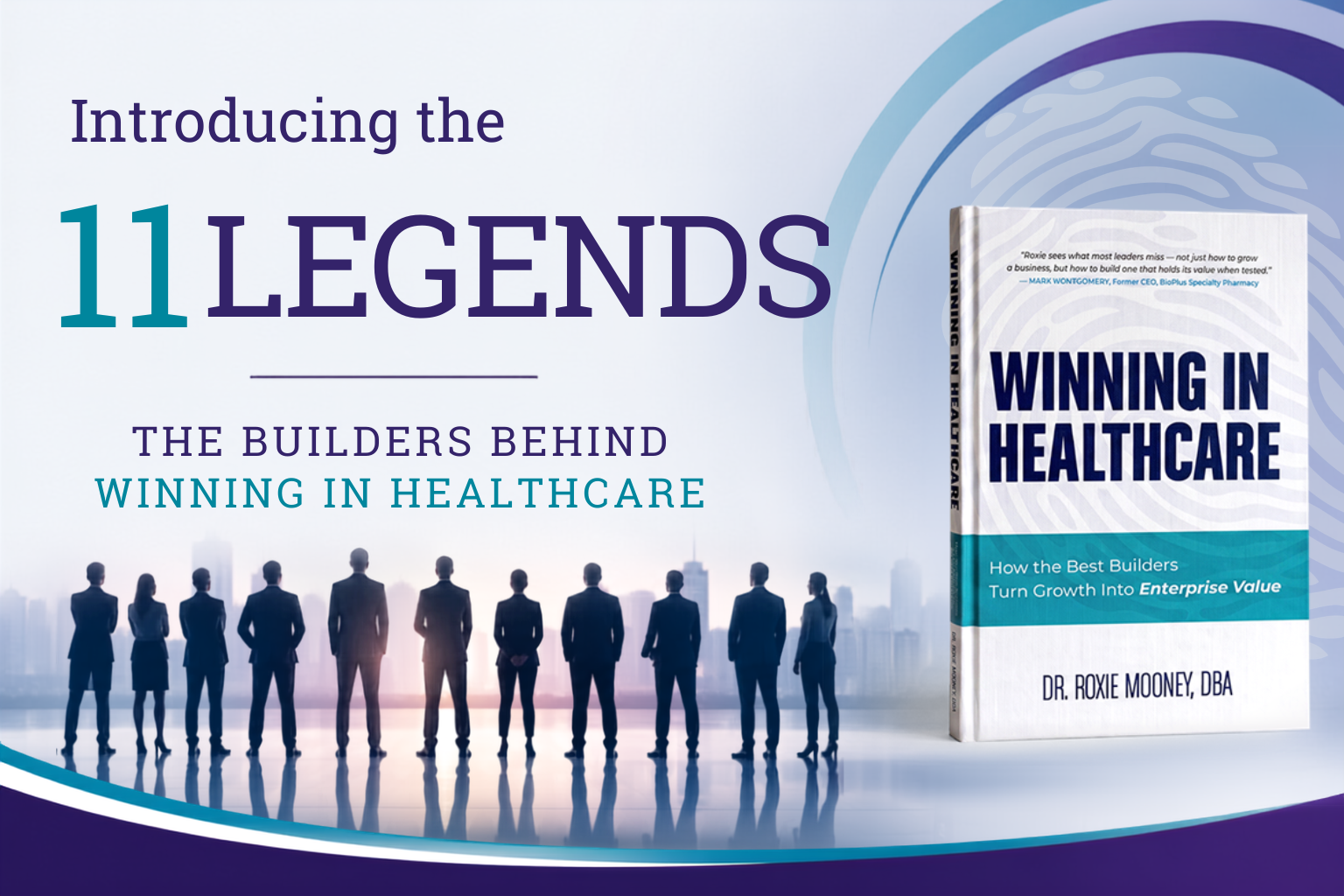
They didn't just grow companies. They built ones that held under pressure, and held up at the exit. Inside the new book from Dr. Roxie Mooney, 11 founders and operators show what it actually takes to turn healthcare innovation into enterprise value.
What holds under pressure
Most healthcare companies don't fail because the idea was wrong. They fail because no one built the system required to survive success.
That line sits at the center of Winning in Healthcare: How the Best Builders Turn Growth Into Enterprise Value, releasing soon from Legacy DNA Press. Across 11 chapters, the book traces founders and operators who built differently, then asks what their stories reveal about translating growth into value buyers will actually pay for.
Some of these names you'll recognize. Others worked in the background, fixing the parts of healthcare no one wanted to touch. All 11 became legends for the same reason: what they built held.
Here's a first look at the cast.
Ali Parsa — Babylon Health
Parsa pushed AI-driven care into the mainstream years before the market was ready, building "an AI doctor in every pocket" that drew millions of patients, a near $4 billion valuation, and intense scrutiny in equal measure. Babylon eventually collapsed. But the story isn't a cautionary tale about failure. It's a study in what happens when ambition outruns the structure built to hold it. His chapter opens Part I: Bold Beginnings, and the first layer of the Enterprise Value Creation System™: not all growth creates value, and not all disruption survives the pressure it creates.
Iman Abuzeid — Incredible Health
Abuzeid didn't try to fix a broken nursing system. She changed who held the power inside it, shifting leverage from hospitals to nurses and unlocking a business model the industry had assumed was fixed. Her chapter introduces the Growth-Enterprise Value Gap, the moment performance slows and the instinct is to push harder, when the real issue was never effort. It was the system.
Temie Giwa-Tubosun — LifeBank
Giwa-Tubosun took the least glamorous part of healthcare, logistics, and turned it into life-saving infrastructure across sub-Saharan Africa. LifeBank has delivered over 45,000 critical supplies and is credited with saving more than 20,000 lives. Her chapter lands the line that defines the whole book: innovation doesn't save lives. Delivery does.
Helmy Eltoukhy — Guardant Health
An engineer, not a doctor, Eltoukhy saw signal where oncology saw noise, and built a blood test that changed how cancer gets caught. Guardant is now a multi-billion-dollar pioneer in precision oncology, used by more than 12,000 oncologists. His chapter makes the case plainly: breakthroughs don't win. Breakthroughs that scale do.
Sean Lane — Olive
A former Air Force intelligence officer who spent five combat tours making sense of chaos, Lane walked into a room of skeptical healthcare executives in 2012 and promised to transform the industry with AI, years before anyone believed that pitch. His chapter opens Part II: Science & Scale and asks the question every builder eventually faces: if your model breaks when it grows, did you scale a business, or just expose a flaw?
Brian Lobley — tango Healthcare
Lobley had visibility, influence, and proximity to one of healthcare's costliest structural failures from inside the payer system, and still couldn't move it from where he sat. So he stepped outside and built tango to solve it instead. His chapter opens Part III: Hidden Operators, and introduces a pattern most companies misread as an effort problem when it's actually a structure problem: marketing, sales, and product operating as disconnected functions instead of one system.
Dr. Ron Razmi — Zoi
A cardiologist turned investor, Razmi sat through thousands of AI pitch decks and learned to separate genuine clinical value from hype, while most capital chased the glossiest slide. His chapter is a sober look at what disciplined judgment looks like in a market where everyone claims the same two letters: AI.
Malinka Walaliyadde — AKASA
Walaliyadde left venture capital to fix the part of healthcare investors found embarrassing: revenue cycle, the invisible factory behind every hospital, where up to 25% of total spend disappears into administration. Everyone agreed it was broken. No one wanted to touch it. His chapter introduces the Value Creation Flywheel, where fixing what others tolerate becomes the thing that compounds.
Robbie Hughes — Lumeon
A canceled surgery, a missed medication step, a $5,000 to $8,000 loss multiplied across thousands of patients a year: Hughes built Lumeon to orchestrate the handoffs healthcare keeps dropping. His chapter is about ownership, and what quietly breaks when no single system, or person, owns the moment between steps.
Meghan Gaffney — Veda
Federal audits found that nearly half of all provider directory listings contain an error. Gaffney, with a background in public policy rather than tech, built the infrastructure to fix it; unglamorous, hard to sell, and exactly the kind of problem investors shrugged off until it worked. Her chapter is proof that the biggest opportunities often hide behind the most boring word in the room.
Mark Montgomery — BioPlus Specialty Pharmacy
Twenty-four consecutive quarters of growth in specialty pharmacy shouldn't happen. Montgomery's chapter closes the book by asking the question every founder eventually has to answer: a great company is not automatically a buyable one. BioPlus became one, not by accident, but by building the discipline and consistency that let buyers trust, understand, and pay a premium for what they saw.
What ties them together
Eleven different industries within healthcare. Eleven different starting points. But the same underlying pattern: growth alone never determined who became a legend. What determined it was whether the system underneath the growth could hold, under scrutiny, under pressure, and under a buyer's microscope.
That's the lens this book puts in your hands, the same Enterprise Value Creation System™ we use with clients preparing for their own growth round or exit.
Before you go
Which builder's story do you want to read first?
Don’t forget, Winning in Healthcare: How the Best Builders Turn Growth Into Enterprise Value releases on July 8th and will be available on Amazon.