
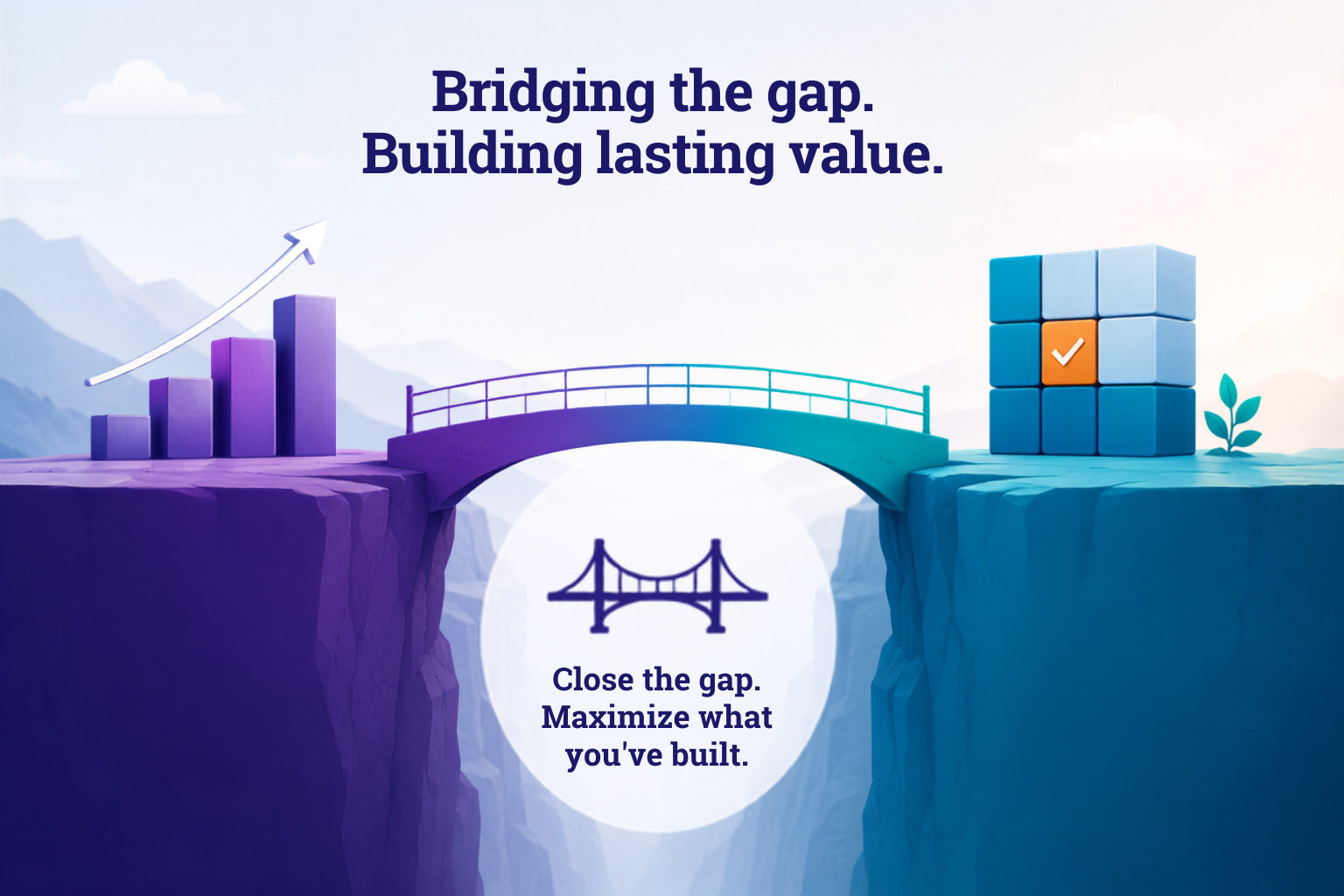
Growth measures momentum. Enterprise value measures whether that momentum is built to last. The two don't always move together, and the gap between them is expensive.
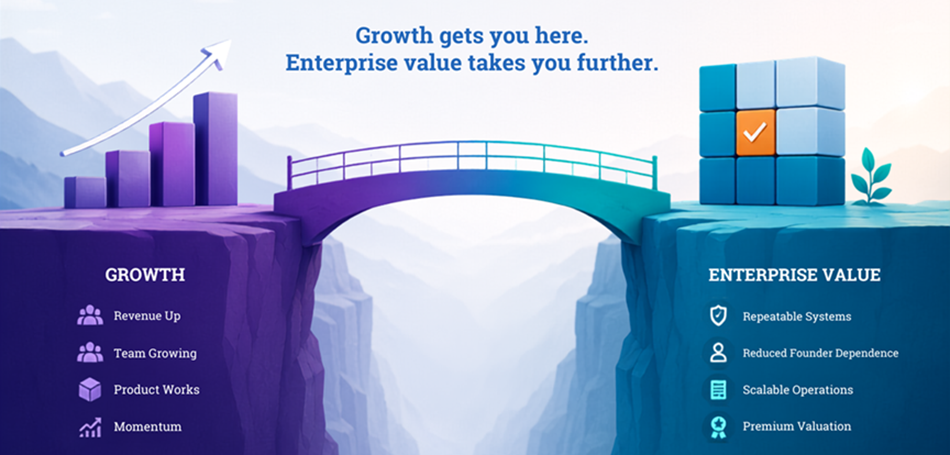
Revenue is up. The team is growing. The product works. By every visible measure, the business looks healthy.
But ask a buyer to look closely, and a different story often shows up. Growth and enterprise value are not the same thing, and the gap between them rarely appears on a dashboard. It surfaces later: in a diligence process, a leadership transition, or the first real attempt to scale without the founder in every room.
That gap is what this piece is about. It is also the idea at the center of Winning in Healthcare, Dr. Roxie Mooney's new book, launching July 8th. Before we get to the stories inside it, the pattern is worth naming plainly.
The growth vs. enterprise value gap, defined
Here is the pattern we see most often in mid-market healthcare companies. Revenue climbs. Headcount grows. The board is pleased. But underneath the growth, the engine producing it was never fully built out. It depends on a handful of people, a few key relationships, or one founder's instincts.
We call this the Growth vs. Enterprise Value Gap. It is the distance between what a business produces today and what a buyer would actually pay for it tomorrow. Growth measures momentum. Enterprise value measures whether that momentum is repeatable, transferable, and built to hold once you step out of the room.
The two can move in entirely different directions, even while the top line still looks strong.
The most dangerous phase isn't failure. It's growth that hides the problem.
Failure gets noticed. When a business is struggling, leadership investigates, investors ask hard questions, and the gaps get addressed quickly.
Growth tends to do the opposite. When revenue is climbing, almost no one stops to ask whether the system underneath it could survive a leadership change, a new market, or a buyer's diligence team. Momentum becomes a stand in for soundness, even when the two have little to do with each other.
A company can grow for years on founder effort and personal relationships and look completely healthy by every operating metric. Until the moment someone tries to value it without the founder in the room. That is when the gap stops being theoretical and starts showing up in the offer.
Effort based growth vs. system-based growth
Not all growth is built the same way, and the difference matters enormously at exit.
Effort based growth depends on the founder closing the important deals, a sales process that lives in someone's head rather than a system and wins that trace back to who you know rather than what the company built.
System based growth looks different. Positioning stays consistent no matter who is speaking. A demand engine produces results independent of any one person. Decisions are documented well enough that a new leader could step in and keep it running.
Both can produce a similar revenue line for years. Only one of them is something a buyer can actually underwrite, because only one of them survives the people who built it walking out the door.
Where this connects to winning in healthcare
This pattern is exactly what Dr. Roxie Mooney set out to document. In her new book, Winning in Healthcare: How the Best Builders Turn Growth into Enterprise Value, you will also see the pattern. Eleven builders, eleven different healthcare companies, and one structure that kept showing up underneath every story that ended in a premium outcome.
Some of these leaders started as outsiders. Some were physicians, engineers, or operators working on problems nobody else wanted. None of them closed the gap by accident. They closed it by building something that worked whether or not they were in the room that day.
Over the coming weeks, we will walk through their stories one at a time and connect each one back to where the gap opens and where it gets closed. The book launches July 8th and you can find it on Amazon, but this is where it starts.
What to do next
The earlier a company identifies whether its growth is effort based or system based, the more room it has to close the gap before a buyer, a board, or a transition forces the question.
If you want a clear, honest read on where your business stands today, a Strategic Fit Call is a 45-minute conversation with Dr. Roxie Mooney. No pitch. No pressure. Just clarity on whether the Enterprise Value Creation System fits where you are right now. That conversation alone is often enough to make the gap visible, well before any formal process begins.
Book a Strategic Fit Call
Learn more about Dr. Roxie Mooney’s new book, “Winning in Healthcare: How the Best Builders Turn Growth Into Enterprise Value”.