
You've run six pilots this year. Each one felt like progress. None of them became revenue.
This is the trap that catches most post-acquisition operators. The pilots close, the demos land, the champions nod, and then the motion stalls in the gap between one function and the next. Marketing hands off leads sales can't convert. Sales makes promises product can't defend. Every pilot pulls people, time, and attention out of the org and gives back a slide deck instead of a deal. It's a constantly depleting motion dressed up as momentum. And a buyer sees straight through it.
What a commercial system actually is
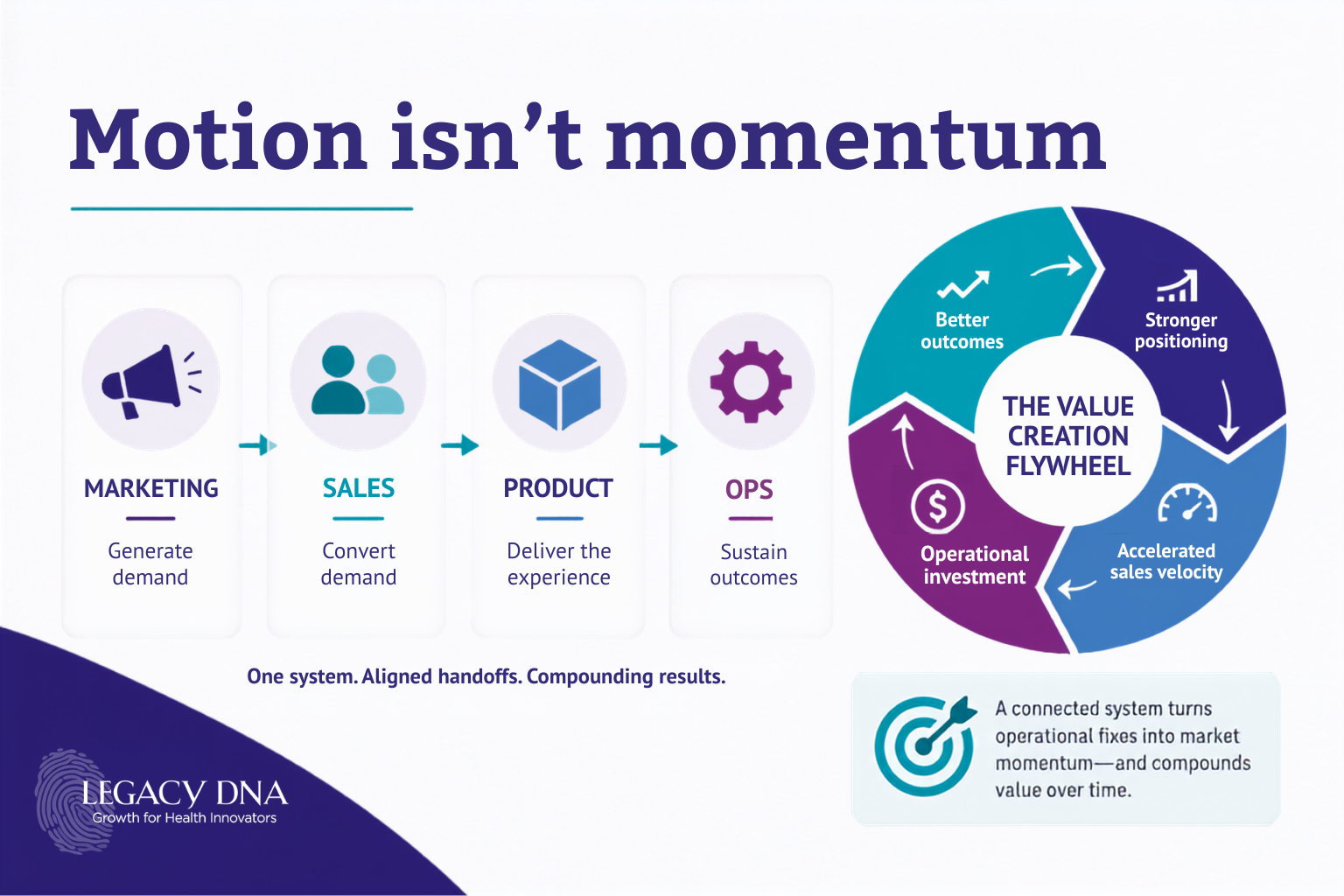
A commercial system is what turns four functions into one engine. Marketing generates demand. Sales converts it. Product delivers the experience. Ops sustains it. That's the theory. In practice, most mid-market healthtech companies run each function independently, each doing its job reasonably well, each compensating for the others when the handoff leaks.
Stage 3 of the Enterprise Value Creation System fixes the architecture underneath. When the four functions reinforce one another, the customer experience stays consistent no matter who's in the room, and handoffs create momentum instead of friction. The result is growth that's repeatable, not dependent on heroic effort or a favorable quarter.
What breaks when it's fragmented
Fragmentation doesn't announce itself. It shows up as symptoms you've learned to tolerate.
New sales leadership inherits a broken pipeline they didn't build. Campaigns generate leads that die because sales lacks the language to close them. Customer success can't stand behind what sales promised. The narrative shifts depending on who's presenting. And every quarter hinges on which deals happen to close in the final two weeks.
This is fragmented GTM, a lack of orchestration. One function compensates for another instead of reinforcing it. Teams work around the system instead of through it. Effort climbs. Leverage doesn't. To a buyer, that reads as an unfinished system, and they price it as one.
Stage 4: the value flywheel
Here's what changes once the system holds. You stop treating operational fixes and market growth as separate workstreams, fix this quarter, grow next quarter, repeat. Instead, you connect what you fix to how you go to market, and you build a loop instead of a list.
That loop is the Value Creation Flywheel. Operational improvement drives better outcomes. Better outcomes strengthen positioning. Stronger positioning accelerates sales velocity. Higher velocity funds the next round of operational investment. The loop tightens with every rotation. No single element creates value alone, it's the connection between them, held under growth pressure, that compounds proof into trust, reputation, and leverage.
The operator's move
If you're scaling a business post-acquisition, the sequence matters more than the speed. The instinct is to launch more pilots, hire more reps, chase more logos. But volume on top of a fragmented system just depletes the org faster.
Build the system on a solid foundation first. Get the handoffs clean, the narrative consistent, the motion documented — cold to sold, repeatable, and no longer dependent on the people who happen to be in the room. Then let the flywheel do the compounding. Once it's turning, growth gets easier over time, not harder. The business generates its own proof, attracts better customers at lower cost, and builds a commercial story that strengthens with every client added.
That's the difference between a company that grew and a company that knows why it grew and can do it again. Buyers pay a premium for the second, because they're not just buying current performance. They're buying the mechanism that sustains it after the transaction closes.
The bottom line
Six pilots with zero momentum isn't a growth problem. It's an orchestration problem, and it caps your multiple long before diligence begins. A repeatable commercial system is what turns a good quarter into a defensible multiple.
See where yours leaks. Book a diagnostic call.
Explore the frameworks behind this: Stage 3 — Commercial System Architecture and Stage 4 — The Value Creation Flywheel.