
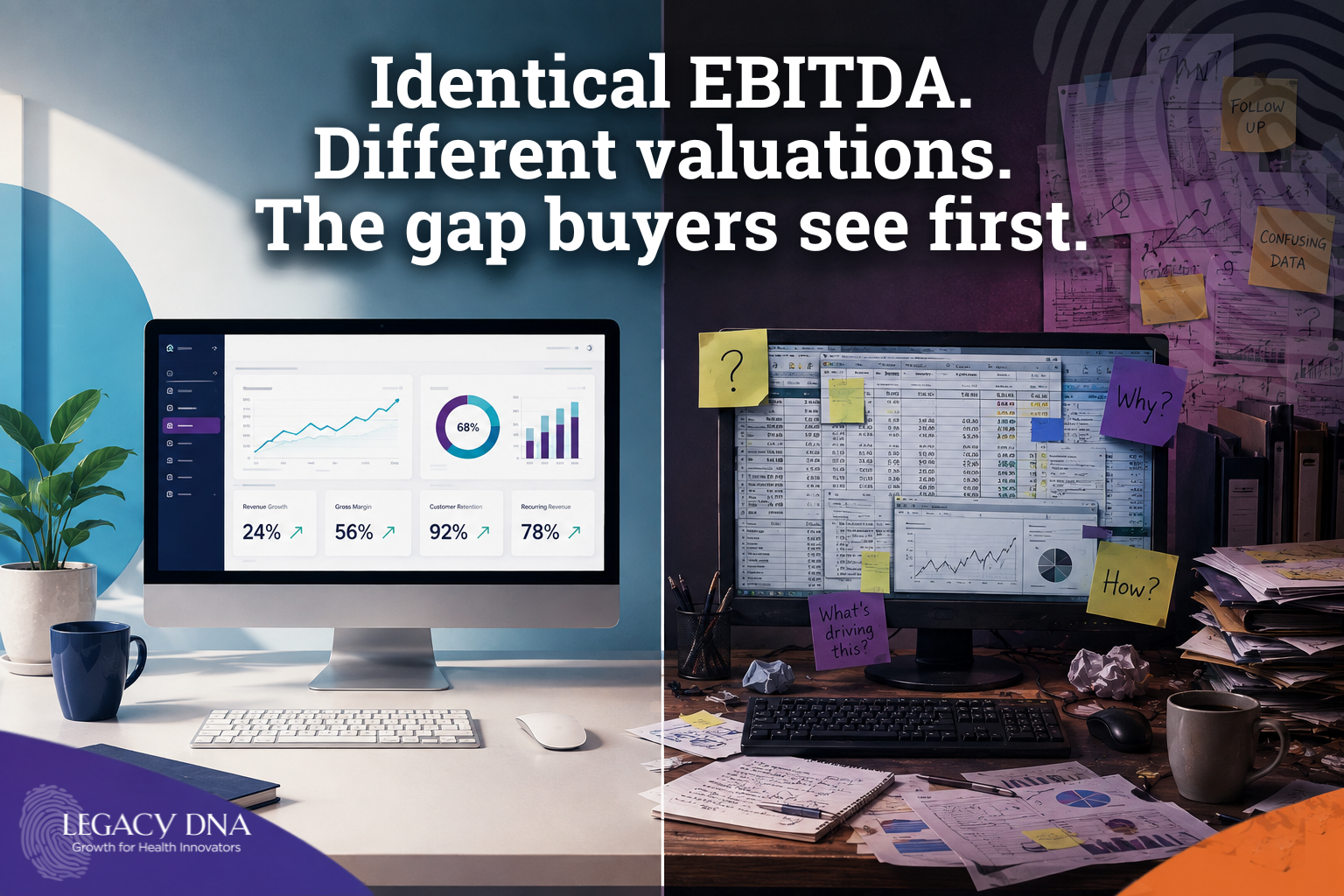
Two healthcare companies can post the same numbers and walk away with very different offers. The variable buyers price first isn't financial, it's whether they can understand why you win.
Same Numbers, Different Offers
Picture two healthcare companies at the negotiating table. Same earnings before interest, taxes, depreciation, and amortization (EBITDA). Same growth rate. Same category. One walks away with a premium multiple. The other gets a discounted offer wrapped in earnouts and conditions.
Founders assume the numbers decide the outcome. They don't. By the time a buyer is weighing a multiple, the financials are table stakes. They’re the price of getting into the room, not the thing that sets the price.
The variable that separates those two offers is clarity. Can a buyer understand, immediately and without help, why this company wins? When the answer is yes, they lean in. When it takes three follow-up calls to get there, they read the confusion as risk, and risk always shows up in the multiple.
What the Value Gap Actually Is
We call this the Value Gap: the distance between how well a company performs and how clearly a buyer can understand that performance.
Most companies obsess over closing the first half of that equation. They drive revenue, tighten margins, and build real operational strength. Then they assume the value will speak for itself. It won't. A buyer doesn't reward the performance they have to excavate, they reward the performance they can see, grasp, and repeat to their own investment committee.
That's the core thesis behind the Enterprise Value Creation System™: enterprise value isn't just built, it's made visible. A business can be genuinely excellent and still leave millions on the table because no one on the buy side could articulate what made it excellent. Structure creates the performance. Clarity is what lets a buyer believe it.
The Three Questions That Reveal Your Gap
Stage 1 of the Enterprise Value Creation System™ measures the Value Gap with three questions. They look simple. Most leadership teams fail at least one.
Can your leadership team consistently articulate why you win? Ask three executives and listen for three versions of the same answer, or three different answers. Buyers notice the variance, and they discount for it.
Would a sophisticated buyer immediately grasp your differentiated value? Not after a deck walkthrough, but immediately — in one clean sentence.
Is your growth creating clarity or complexity? As you add products, markets, and motions, is your story getting sharper or harder to follow?
If any answer gives you pause, the gap is already there. Better to find it now than to have a buyer find it for you.
Why Growth Quietly Widens the Gap
Here's the part that catches strong operators off guard: growth often makes the Value Gap worse, not better.
Every new product line, every new market, every new go-to-market motion adds surface area, one more thing a buyer has to underwrite, one more sentence in a pitch that was already getting long. What feels like momentum from the inside reads as sprawl from the outside. The company knows how it all connects. The buyer sees a collection of bets and starts pricing the uncertainty.
This is why fast-growing companies are so often undervalued. It isn't the performance. It's that the performance outran the story. The growth was real, but it was never re-anchored to a single, defensible reason the company wins, and the buyer couldn't hold the whole thing in one hand.
What Closing the Gap Looks Like
Closing the Value Gap doesn't mean changing the business. It means making the business legible.
The test is simple: can a buyer repeat your positioning back to you, accurately and without you in the room? When your differentiation is so clear that someone else can carry it into their investment committee and defend it, you've closed the gap. You're no longer one option in a crowded comparison. You're a category of one, and categories of one don't get benchmarked against a comp set, they get pursued.
That's the shift a premium multiple is built on. Not louder marketing. Not a bigger deck. A single, sharp answer to why you win that holds up whether or not the founder is in the room to deliver it.
Run the Diagnostic Before a Buyer Does
In diligence, a buyer will score your Value Gap whether you've measured it or not. The only question is whether you see the number first.
The Enterprise Value Gap Diagnostic is where that starts. It’s an honest read of how clearly your growth story would land in a buyer's hands, and where complexity is quietly costing you multiple.
First step: get an outside read. Start with your Strategic Fit Call.
The full pattern behind this, the six stages that turn growth into enterprise value buyers pay a premium for, is in Winning in Healthcare, now available on Amazon.